
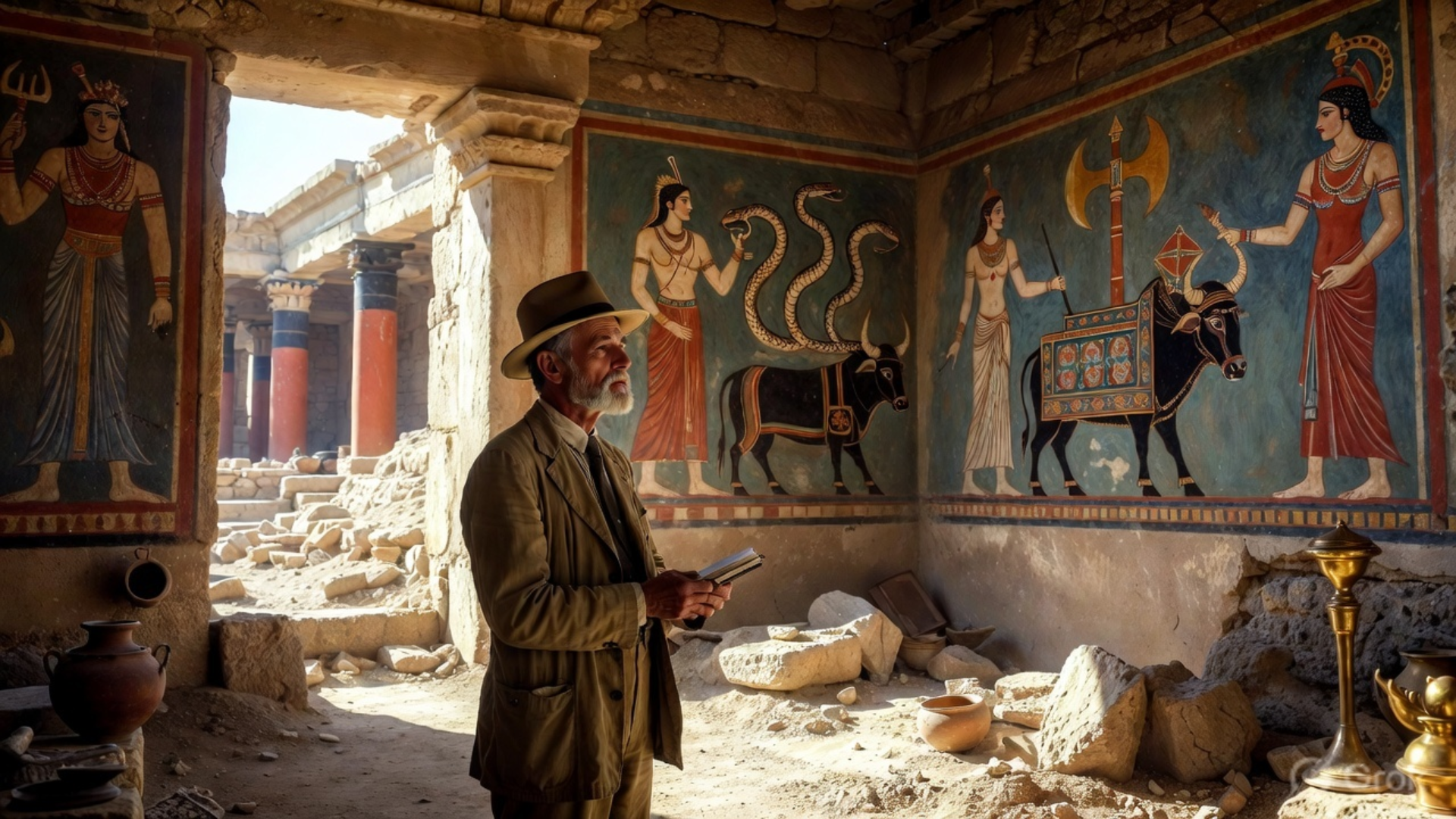
The discovery of the Minoan civilization on the island of Crete revolutionized archaeology, largely due to the work of Sir Arthur Evans, who excavated the Palace of Knossos between 1900 and 1931.
Evans uncovered thousands of artifacts, frescoes, and figurines dating from approximately 2000 BCE to 1400 BCE. While his discoveries were groundbreaking, modern archaeology shows that Evans misinterpreted many aspects of Minoan religion, especially its deities, due to limited evidence and personal assumptions.
The Discovery and Reconstruction of the Snake Goddess
One of Evans’s most famous finds was the Snake Goddess figurines, discovered in 1903 at Knossos and dated to around 1600 BCE. These figurines depicted a female figure holding snakes, wearing elaborate clothing, and exposing the upper body, which Evans interpreted as a symbol of fertility and divine power.
However, the figurines were found in fragments. Evans reconstructed missing parts, including the arms, crown, and posture. Modern experts believe these reconstructions may not accurately reflect the original artifact.
Some researchers now suggest these figures may represent priestesses, ritual participants, or symbolic protectors, rather than a single central goddess.
Evans’s “Great Mother Goddess” Theory
Evans concluded that Minoan religion was centered on a single Great Mother Goddess, whom he believed controlled nature, fertility, and life cycles. He argued that male figures in Minoan art played secondary roles.
This interpretation was influenced by early 20th-century theories about ancient matriarchal societies. Evans applied these ideas broadly, even though archaeological evidence showed varied symbols, multiple female figures, and diverse religious scenes, suggesting a more complex belief system.
Evidence of Multiple Deities and Religious Roles
Modern archaeological analysis reveals that Minoan religion was likely polytheistic, meaning it included multiple deities. Evidence includes:
- Different female figures in frescoes and seals with unique clothing and symbols
- Religious scenes showing both male and female participants
- Sacred locations such as peak sanctuaries, caves, and palace shrines
- Clay tablets and ritual objects indicating diverse religious practices
These discoveries suggest that Minoan religion involved multiple divine figures, priestesses, and ceremonial roles, not just one central goddess.
Key Facts About Sir Arthur Evans and Minoan Religion
| Category | Details |
|---|---|
| Archaeologist | Sir Arthur Evans |
| Major excavation site | Knossos, Crete |
| Excavation period | 1900–1931 |
| Civilization period | 2000 BCE–1400 BCE |
| Famous discovery | Snake Goddess figurines |
| Figurine date | Around 1600 BCE |
| Evans’s theory | Single Mother Goddess religion |
| Modern interpretation | Complex polytheistic belief system |
Why Evans Misinterpreted Minoan Deities
Several factors contributed to Evans’s misinterpretation:
- Fragmented artifacts requiring reconstruction
- Lack of written records from the Minoan civilization
- Influence of contemporary academic theories
- Desire to create a clear and unified explanation
These limitations led Evans to oversimplify a complex religious system.
Sir Arthur Evans played a crucial role in uncovering the Minoan civilization, but his interpretation of its deities was shaped by assumptions and incomplete evidence. Modern archaeology shows that Minoan religion was far more complex, involving multiple divine figures and ritual roles. E
]vans’s work remains historically important, yet it also highlights how archaeological interpretations must evolve as new evidence and analytical methods emerge.
FAQs
When did Sir Arthur Evans excavate Knossos?
Sir Arthur Evans excavated Knossos between 1900 and 1931, uncovering the remains of the Minoan civilization.
What was Evans’s main interpretation of Minoan religion?
Evans believed Minoan religion focused on a single Mother Goddess, but modern research suggests multiple deities existed.
Why do modern scholars question Evans’s interpretation?
Because many artifacts were incomplete, and Evans reconstructed and interpreted them based on personal theories rather than definitive evidence.